
Eschrichtiidae
Gray Whale
E. robustus
Least ConcernGray Whales
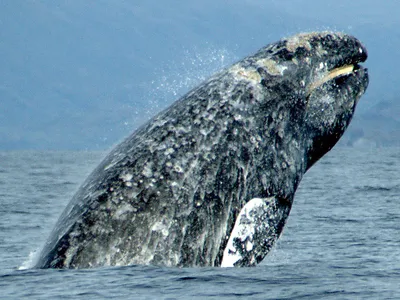
A family of one: the gray whale, the only cetacean that feeds by ploughing the sea floor for buried amphipods.
Eschrichtiidae contains a single living species. It sits between the rorquals and the right whales in build and in habit — two to five short throat grooves rather than a rorqual’s dozens of pleats, no dorsal fin but a low hump followed by a series of knuckles along the tail stock, and skin mottled gray and encrusted with barnacles and whale lice to a degree found in no other whale.
Its feeding is unique among cetaceans. The whale rolls onto its side, usually the right, presses its head into soft sediment and suctions up a mouthful of sea floor, straining out tube-dwelling amphipods and leaving oval pits that are visible in side-scan sonar surveys of the Bering and Chukchi shelves. The baleen on the preferred side is measurably shorter and more worn.
The eastern North Pacific population makes one of the longest migrations of any mammal, an annual round trip of roughly sixteen to twenty thousand kilometres between Arctic feeding grounds and the breeding lagoons of Baja California. A separate western Pacific population remains very small. A third, Atlantic population existed into the early modern period and was gone by around 1700 — although animals have recently appeared in the Mediterranean and the North Atlantic, presumably having crossed a seasonally ice-free Northwest Passage.