
Eschrichtiidae
Gray Whale
E. robustus
Least ConcernThe gray whale alone — a bottom-feeding migrant that was lost from the Atlantic three centuries ago and has lately begun reappearing there.
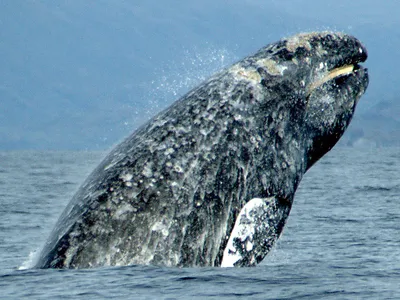
Eschrichtius is monotypic and morphologically isolated: no dorsal fin, a modest set of throat grooves, and a thick, mottled body carrying more barnacles and whale lice than any other cetacean. It is the only whale that makes its living from the sea floor, and the wear on its baleen records which side it habitually rolls onto.
It is also the only large whale to have been driven out of an entire ocean and then to have started returning. Subfossil remains show gray whales along the coasts of Europe and eastern North America until roughly the seventeenth century, after which the Atlantic population disappeared. Since 2010 individuals have turned up in the Mediterranean, off Namibia and off the north-eastern United States — animals that had almost certainly crossed from the Pacific through a Northwest Passage now seasonally free of ice.