
Balaenopteridae
Humpback Whale
M. novaeangliae
Least ConcernA single species, the humpback whale, distinguished by flippers a third of its body length and by song that changes every season.
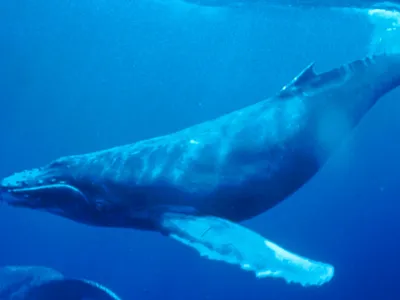
The name means "big wing", for pectoral flippers that reach up to a third of body length — proportionally the longest of any whale, and used both in manoeuvring and in striking. The rostrum and jaw carry rows of tubercles, each containing a single sensory hair, and the body is stockier and more barnacle-encrusted than any other rorqual’s.
Humpbacks are the most behaviourally conspicuous of the great whales. They feed cooperatively by releasing curtains and rings of bubbles to concentrate prey, they breach more than any comparable animal, and the males produce long songs with a nested, repeating structure. A population’s song changes progressively through a breeding season and is adopted wholesale by neighbouring populations, spreading eastward across the South Pacific in successive years.
The underside of the fluke is individually patterned and is raised on a deep dive, which produced global photo-identification catalogues decades before genetic methods were available. The species was reduced to a few per cent of its original numbers by twentieth-century whaling and has since recovered strongly enough to be listed as Least Concern.