
Monodontidae
Narwhal
M. monoceros
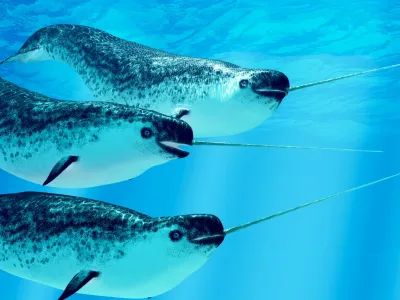
Least ConcernThe narwhal: a single species whose male carries a three-metre spiralled tusk, a canine tooth that grew through the lip.
Monodon means "one tooth", and that is literally the dentition. A narwhal has no functional teeth in its mouth. What it has is a pair of upper canines embedded in the skull, of which the left, in almost all males and roughly one female in seven, erupts through the upper lip and grows forward into a helical tusk that can exceed three metres. The spiral runs counter-clockwise in every recorded animal, and in the rare double-tusked individuals both spiral the same way.
The tusk is not a typical tooth. It is porous, with dentinal tubules running from a central nerve to the outer surface, and experimental work has shown physiological responses to changes in the surrounding water — evidence for a sensory function. It is also used: drone footage has recorded narwhals striking fish with it, and the scarring and broken tips on mature males indicate it is used against each other as well.
Narwhals winter in dense pack ice in Baffin Bay and the Greenland Sea, diving to fifteen hundred metres in near-total darkness for Greenland halibut, and summer in the fjords of the Canadian High Arctic and Greenland. They are among the Arctic endemics considered most sensitive to sea-ice loss and to increased shipping noise.